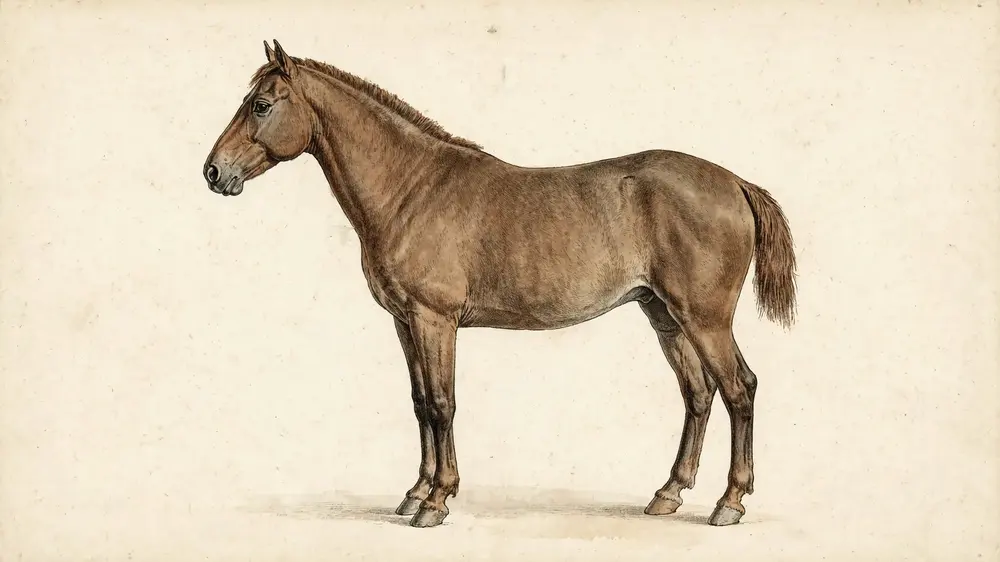
Baladi horse
حصان بلدي
Draft: needs vet review
- Type
- Horses
- Region
- Egypt
- Main use
- Work
- Known for
- Hardy, cheap to keep
Quick facts
This information is general. For doses and treatment, always ask your vet.
About
Hardy, cheap to keep
Real photos are coming, each with the photographer's name and license.
Benefits & uses
Work
Food
Hay or berseem first, little and often. Grain only in hard work. Salt and clean water.
Common vaccines
Tetanus, equine influenza, rabies where present.
Draft: needs vet review
Water and general notes: Water 25-50 liters, and salt about 50 g.
Feeding by stage and goal
| Stage | Weight / goal (kg) | Intake (% of weight) | Ration protein (%) | Energy TDN (%) | Daily ration example |
|---|---|---|---|---|---|
| Foal (0-6 months) | 45-250 | 16-18 | Colostrum first 2-3 hours, mother's milk, and from two months old, a starter of 0.5 kg for each month of age | ||
| Weanling (6-12 months) | 200-300 | 2.5-3 | 14-15 | Good quality hay ad lib + 2-3 kg concentrate | |
| One to two years old | 300-400 | 2-2.5 | 12-13 | Hay + 2 kg concentrate | |
| Horse at rest | 400-500 | 1.5-2 | 8-10 | 7-9 kg hay, no need for grains | |
| Light work | 400-500 | 2 | 10 | Hay + 1-2 kg concentrate | |
| Hard work or racing | 400-500 | 2.5 | 11-12 | Hay + 3-5 kg concentrate over 3 meals, and the meal should not exceed 2 kg of grains | |
| Pregnant mare: last 3 months | 400-500 | 2 | 11-12 | Hay + 1.5-3 kg concentrate | |
| Lactating mare (first 3 months) | 400-500 | 2.5-3 | 13-14 | Hay ad lib + 3-5 kg concentrate | |
| Stallion in breeding season | 450-550 | 2 | 10-11 | Hay + 2-3 kg concentrate |
Concentrate mixtures (parts per 100 kg)
| Mixture | Barley | Yellow corn | Bran | Soybean meal 44% | Molasses | Limestone | Salt | Minerals | Approx. protein |
|---|---|---|---|---|---|---|---|---|---|
| Foal starter | 20 | 40 | 15 | 20 | 2 | 1.5 | 0.5 | 1 | 17% |
| Working horses and mares | 40 | 25 | 20 | 10 | 2 | 1.5 | 0.5 | 1 | 14% |
Roughage should not be less than 1.5% of the horse's body weight per day. Sudden changes in feed are a major cause of colic and laminitis.
Vaccine and care calendar, from birth to sale
| Age / timing | Action |
|---|---|
| Day of birth | Colostrum within 2-3 hours, disinfect navel, ensure first meconium passes |
| Two months | First deworming, then every 2-3 months until one year old |
| 4-6 months | Tetanus, two doses 4-6 weeks apart |
| 6 months | Equine influenza: one dose, a second after 4-6 weeks, and a third after 6 months |
| As per region | Rabies, strangles, and herpes where recommended |
| Every year | Tetanus and influenza every 6-12 months depending on activity |
| Pregnant mare | Herpes at months 1, 7, 9 of pregnancy, and a tetanus and influenza booster 4-6 weeks before foaling |
| Every 6-8 weeks | Hoof trimming or shoeing |
| Every year | Dental check and floating if necessary, deworming adults based on fecal test |
Common diseases
| Disease | Signs | What to do | Prevention |
|---|---|---|---|
| Colic | Kicks at belly, rolls, looks at flank, not passing manure | Emergency: vet immediately, do not give food | Change feed gradually, water always available, parasite control |
| Laminitis | Lameness in front legs, hot hoof, shifts weight back | Emergency: vet immediately | Don't increase grains suddenly, prevent obesity |
| Tetanus | Body stiffness, third eyelid covers the eye, difficulty chewing | Vet immediately | Vaccination, cleaning wounds |
| Equine Influenza | Fever, dry cough, nasal discharge | Complete rest and vet | Vaccination, isolate new arrivals |
| Strangles | Fever, swelling of glands under the jaw, pus from the nose | Isolate and vet | Isolate new arrivals, separate equipment |
| Worms | Weight loss, dull coat, recurrent colic | Vet | Deworming based on fecal test, stable hygiene |
Related breeds
Track your Baladi horse herd with Qatee3
Join the waitlistThis information is general. For doses and treatment, always ask your vet.